


Juvenile detention and residential facilities house youth who are either awaiting court decisions or receiving court-ordered treatment. Collectively, they are part of the out-of-home placement system.

Out-of-Home Placement for Michigan Youth
Juvenile detention facilities provide temporary care for youth who require custody in a physically restrictive place while awaiting court action or longer-term placement.
Residential placement includes secure and nonsecure facilities. A residential treatment facility offers longer-term, goal-oriented treatment programs for youth.
In Michigan, the out-of-home placement system includes not only state-operated facilities, but also county-run, court-operated, and private facilities. While these placements are intended to provide treatment in safe conditions, there is no guarantee that children will not experience physical, mental, or emotional harm. Removing a child from their home always carries an inherent risk to their well-being.
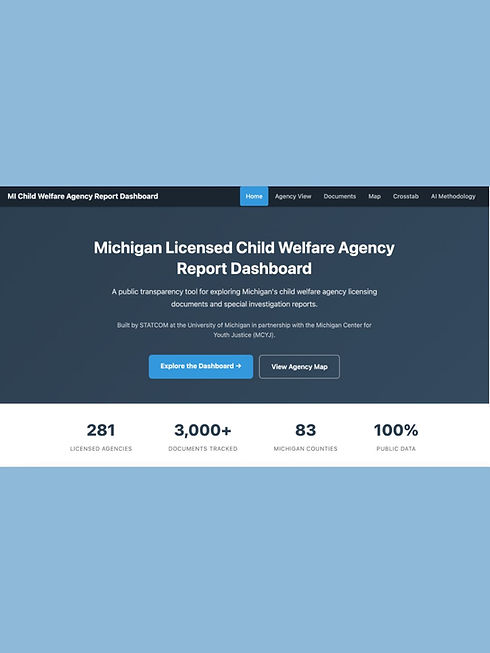
Michigan Licensed Child Welfare Report Dashboard
There are hundreds of child caring institutions in Michigan, and thousands of reports generated among them. It’s hard for the everyday person, journalist, advocate, or researcher to ensure Michigan’s children are being taken care of and not falling through the cracks of the system.
That’s why MCYJ, with the help of the University of Michigan’s STATCOM program, has created a free, publicly accessible tool to help the public parse through reports on child welfare incidents.
We strongly encourage individuals to review our user guide before accessing the tool. You can find the user guide here, with a glossary of terms, disclaimers, and instructions on how to navigate the dashboard.
Access the Michigan Licensed Child Welfare Report Dashboard here.
Quick Facts:
-
In Michigan, many youth are placed in detention for low-level, nonviolent offenses.
-
The national average annual cost of securely confining a young person is $214,620 (which could break down to about $600 a day), while community-based programs can cost as little as $75 per day per youth.
-
A working paper found that placement in juvenile detention in Michigan reduces the likelihood of high school graduation by 31%.
Michigan’s Main Challenges
The justice system is a complex network with many challenges that stem from the system, funding, policy, or all of the above. Here is just a snapshot of how those challenges are reflected in Michigan.
-
Research shows that a significant portion of youth in detention have at least one psychiatric disorder.
-
It has been reported that, to access pediatric mental health treatment, some families are only able to find mental health services through the juvenile justice system.
-
Many residential facilities are not equipped to handle youth with complex mental health needs.
Opportunities for Transformation
There is no one-size-fits-all solution to the complex issues facing this system. However, the State of Michigan is well positioned to address these challenges in ways that benefit youth, families, and judicial stakeholders. Some options include a real-time census, investing in staffing, expanding short-term treatment options, and regional mental health planning.
To read our in-depth recommendations, as well as a deeper exploration of the out-of-home placement system, click here.